Author: christine

  • Silhouette Cameo Print and Cut Tax Reminder Planner Stickers

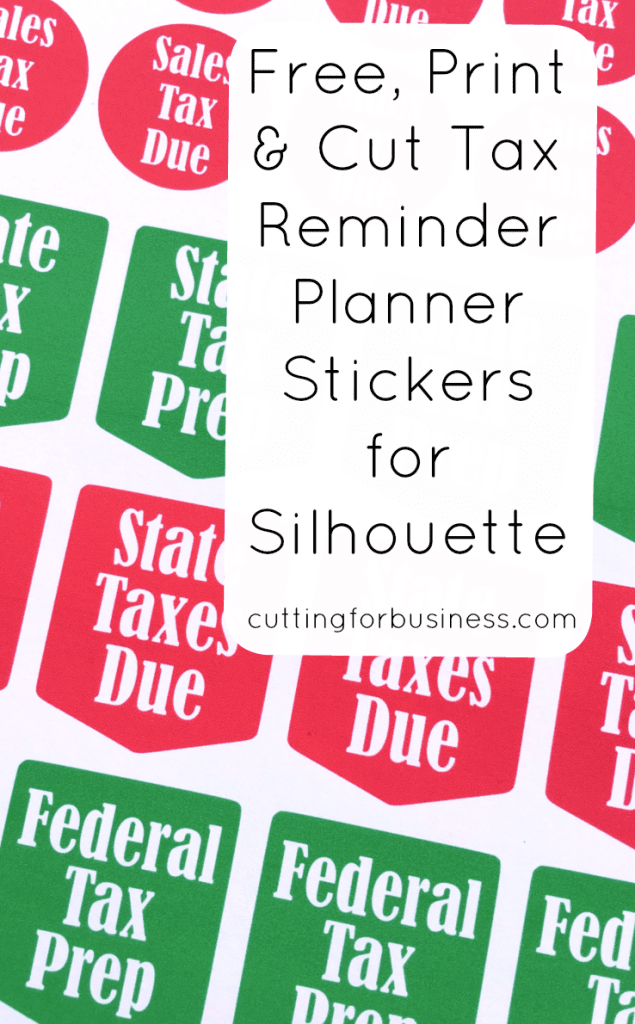
    We made it through tax week at Cutting for Business! If you missed any posts along the way, I talked about sales tax, an overview of taxes, tax deductions, and I shared a printable tax preparation list. Today, I’m sharing print and cut Silhouette Cameo calendar or planner tax reminder stickers. As I mentioned, the fees can be quite high for filing your tax returns late – so I’m making sure that you are right on time!

    This file is for personal use only and cannot be sold or uploaded elsewhere. Enjoy!

    Silhouette users can download the file in .studio3 format here.

    Silhouette Cameo Print and Cut Tax Reminder Planner Stickers by cuttingforbusiness.com

  • Printable Tax Prep Checklist for Silhouette or Cricut Small Businesses

    Let’s keep talking taxes! (I know, you are probably groaning right now, but this stuff is important!)

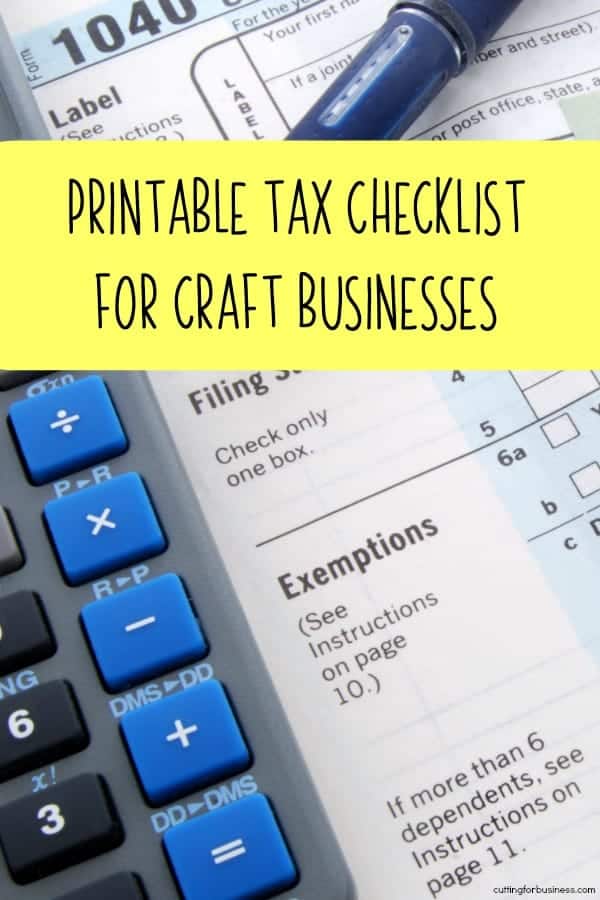
    Whether you are filing your taxes yourself or bringing them to a tax professional, I’m offering you a printable checklist of everything you need to have on hand before you begin.

    Download the Printable Tax Checklist here.

    Printable Tax Prep Checklist for Silhouette or Cricut Small Craft Businesses - by cuttingforbusiness.com

  • Tax Deductions in Your Silhouette or Cricut Business

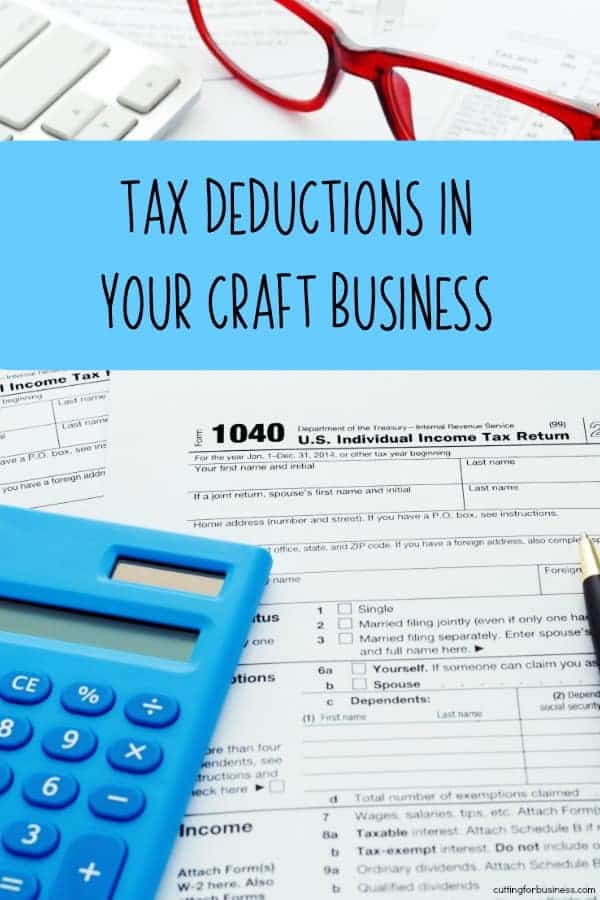
    As we continue on talking about taxes on the blog (see this post and this post if you are a bit behind), we are going to look at a list of common tax deductions in your Silhouette or Cricut business.

    Tax deductions are expenses that your business has encountered throughout the year. You use deductions to reduce the taxable income that your business has had throughout the year – thus allowing you to pay less in taxes at the end of the year.

    Two Kinds of Deductions

    For some deductions, you take the entire value of the deduction at one time; while others you take a portion of the deduction over several years. For example, you may take a deduction of $40 for vinyl you recently purchased. However, since you will continue to use your machine throughout several years, your machine depreciates and you take smaller deductions over the useful life of your machine.

    Common Tax Deductions in Your Silhouette or Cricut Business

    • Supplies – Vinyl, paper, glue, transfer tape, weeding tools, blank products, and so on.
    • Machines – Cameo, Curio, Mint, Cricut, Alta, Glowforge, heat press, postage scale or printer, computer you purchased for business use, or camera and related photography equipment.
    • Software – Like Silhouette Studio Designer or Business Edition Upgrade, fonts, and designs.
    • Books – Any book you’ve purchased to better your business or to improve your skills (like Diving In: 30 Days to Your Silhouette Business – shameless plug to one of my books).
    • Insurance – Business insurance.
    • Event Entry Fees – Like those from craft shows or fairs.
    • Home Office Overhead – The space in your home you use for your business, internet, electricity, water.
    • Legal Fees – These include attorney fees from setting up your business, trademarking your designs, registering copyrights.
    • General Office Supplies – These would include envelopes, tape, pens, pencils, tacks, staples, file folders, and so on.
    • Postage and Shipping Supplies – Don’t forget about boxes, envelopes, tape, packing peanuts, bubble wrap, and labels.
    • Advertising Expenses – Including promoted listings on Etsy, Pinterest, Facebook, Google Adwords, and print materials including business cards or post cards.
    • Tax Preparation Expenses
    • Accounting Expenses – Including monthly accounting subscription, or the costs related with hiring an accountant.
    • Phone expenses – Cell phone bills, phone, phone apps for your business.
    • Travel Expenses – You can deduct things like gas, lodging, food.
    • Start Up Costs – Usually, you can deduct up to $5,000.
    • Credit Card Processing Fees
    • Display Materials and Photography Props
    • Charitable Donations – This includes product donations for fundraisers.
    • Health Insurance Premiums
    • Childcare Expenses.
    • …most things that you have purchased for use in your business can be taken as a tax deduction.

    Whew, that’s a lot of deductions! When taking deductions related to your Silhouette or Cricut business, the IRS will not ask for copies of each receipt. However, you are required to keep your receipts on file, either digitally or hard copies. Personally, I keep paper records in binders.

    Tax Deductions in Your Silhouette or Cricut Business Craft Business - by cuttingforbusiness.com

  • Income Tax and Self Employment Tax in Your Silhouette Business

    Let’s continue talking taxes here on the blog. I’ve already shared with you what the IRS says about business income versus hobby income. Missed it? Read that post here.

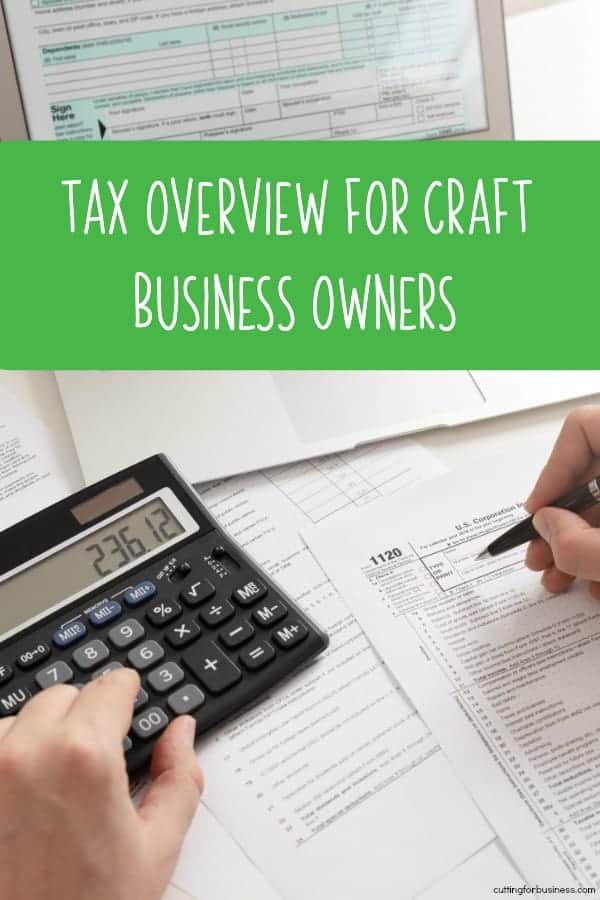
    Today, we are going to look at Federal and State Income Tax and Self Employment Tax in your Silhouette or Cricut small business. To clarify, I can’t provide specific answers for your tax questions since I’m not a licensed tax professional, but I’m happy to provide you an overview of the taxes you’ll encounter in your Silhouette or Cricut small business.

    Federal and State Income Tax

    • In general, when you make money you need to pay income taxes. I’m sure most Cutting for Business readers have been employed and have received a W-2 at some point in their lives. At tax filing time, you use the information on your W-2 to report to the government how much money you earned during the year. When you work for yourself, no one sends you a W-2. Instead, you add your net sales income to all your other income and report it to the government on your Federal Form 1040 or your state income tax return.
    • Not all states have income tax. These states include: Alaska, Florida, Nevada, South Dakota, Texas, Washington, and Wyoming.
    • Federal and State Income taxes are filed annually.
    • Similar to filing your personal taxes, you will offset your taxable income with your business deductions.

    Federal Self Employment Tax

    • In the USA, there is a 15.3% Self Employment tax. The purpose of the tax is to collect Social Security and Medicare taxes from those that are self employed. Of the 15.3%, 12.4% goes to Social Security; while 2.9% goes to Medicare. In 2020, you will pay 15.3% of the first $137,700 in income. For earnings over $137,700 you are taxed at 2.9%; the income amounts change yearly.

    How are Small Business Taxes Filed?

    For those with sole proprietorships or single member LLC’s (which are what the majority of Cutting for Business readers will be established as), you will file your taxes on your personal tax return (Form 1040) or your state income tax form.

    1099-K

    If you sell through marketplaces (Etsy, Ebay, Amazon)  you may receive a 1099-K. For this to happen, you must have $20,000 AND more than 200 transactions. This form simply states what your unadjusted gross sales were within the marketplace.

    See, this tax stuff isn’t really that scary! I do know this tax stuff can be pretty dull, but have faith and get your tax documents in order sooner rather than later.

    Income Tax and Self Employment Tax in Your Silhouette or Cricut Small Business - by cuttingforbusiness.com

  • Should You Be Charging Sales Tax to Your Customers?

    In addition to all the recent talk about Federal and State taxes over the last few weeks, let’s switch over and talk about Sales Tax.

    What is Sales Tax?

    Sales tax doesn’t cost your business anything. Instead, you act as the middleman and collect sales tax from your customer and submit it to your state. Additionally, Currently, for items sold online and shipped to customers out of your state (or out of a state that you formally do business in) – there is no sales tax. When selling to a customer in your state, you will need to charge them sales tax.

    How to Collect Sales Tax and How Much to Charge?

    To begin collecting sales tax, you will need to register with your state’s Department of Revenue. Registration can generally be done online. 

    The sales tax amount that you charge will vary depending on the state you live in and the sales tax structure that they operate upon. Some states use an origin based rate (tax amounts are determined by where you live); while others use a destination based rate (tax amounts are determined by the destination of the buyer). In addition to the state sales tax rate, your county or city may have additional sales tax surcharges. For example, in my home state (Florida) the sales tax rate is 6% and my county (Osceola) has a 1% county surcharge for a total sales tax rate of 7%.

    How and When to Submit Sales Tax?

    Again, your state’s Department of Revenue will be able to provide you specific details on submitting your sales tax. In many states, new filers pay sales tax quarterly – but other common sales tax due dates are monthly or yearly. Some states will provide on time filers with a credit for filing on time, while others have high late fees for filers who don’t file on time.

    What States Don’t Have Sales Tax?

    There are always exceptions! Five states in the USA have no sales tax: Alaska, Montana, New Hampshire, Delaware, and Oregon. If you live in one of these states, you may still have tax responsibilities in other states. Read more about this in this post.

    Too Busy to File Sales Tax?

    Too busy to worry about sales tax filings? I hear you! I use (and love!) a service that does this automatically for me. Read my full review in this post.

    Pin the image below to Pinterest:

    Should You Be Charging Sales Tax to Your Customers in Your Silhouette Cameo or Portrait and Cricut Explore or Maker Business? By cuttingforbusiness.com.

  • Grammar Guide for Crafters: How to Make Names Plural in Craft Projects

    Today, we are going to have a quick refresher on how to make names plural in craft projects.

    I see so many errors online in products for sale. Quite frankly, misspelled products are pretty embarrassing!

    Grammar Guide for Crafters: How to Make Names Plural in Craft Projects - cuttingforbusiness.com

    How to Make a Last Name Plural

    Q: When should you make names plural?
    A: When you are talking about more than one person with the same last name.
    How: In most cases, to make a name plural you add an S.

    Examples: Johnson becomes Johnsons. Smith becomes Smiths. Hall becomes Halls.

    Exceptions: To make names that end in S, X, Z, CH, or SH plural you add ES.
    Examples: Hernandez becomes Hernandezes. Mitch becomes Mitches. Holmes becomes Holmeses.

    Don’t forget: You never use an apostrophe when you are talking about more than one person with the same last name.

    When to Use an Apostrophe

    Q: When should you use an apostrophe?
    A: An apostrophe shows possession, and is only used when you are referring to something that someone owns.
    How: To show possession add ‘S. This is called a singular possessive.

    Examples: Mrs. Schinagl’s house is beautiful. Mr. White’s car is blue. Ms. Patterson’s neighbor had a baby.

    Exceptions: When a last name ends in S, you can either add ‘S or just an apostrophe (‘). Grammatically speaking, both are correct.
    Examples: Pattersons: We ate at Mrs. Pattersons’s house or we ate at Mrs. Pattersons’ house. Sanders: We rode in Mr. Sanders’s car or we rode in Mr. Sanders’ car.

    Q: What if you need to use a plural and an apostrophe in the same name?
    A: First, make the name plural; then make it possessive. This is called plural possessive.

    Example: When writing about the house of the Roberts family: We went to the Robertses’ house. First I made the name plural (Robertses) then I added an apostrophe to show that I was talking about their house.

    Plural versus Singular Possessive versus Plural Possessive

    Another example before you go:

    Last name: Robinson.

    The Robinsons invited us to a party at their house. (Only plural, refers to more than one person with the last name Robinson.)
    We went to Mrs. Robinson’s house. (Singular possessive. Talking about a house owned by a person.)
    We went to the Robinsons’ house. (Plural possessive. Talking about more than one Robinson and their house.)

    It’s a Good Idea to Verify with the Customer

    When creating personalized products for customers that have exceptions related to their names, it is always a good idea to ask specifically how they want their name to appear. For example, the Jones family may not want the name to read The Joneses. As an alternative, you can avoid the plural by using The Jones Family.

    What About a Grammar Checker?

    Need help with grammar or other proofreading in your craft business? I’ve got you covered in this article: How Crafters Can Use Free AI Tools as Grammar Checkers.

  • Black Friday, Small Business Saturday, and Cyber Monday Sale Ideas for Crafters

    We are getting ready to kick off the Holiday shopping season at the end of the week with Black Friday, followed by Small Business Saturday, and Cyber Monday. As a small craft business owner, I urge you to take advantage of at least one of these high shopping days by offering a sale or special in your online store. Today, I’m giving you some quick ideas for you to use this week – and not go broke!

    2015 Dates

    • Black Friday is Friday, November 27th, 2015. It’s generally the kick off to the holiday shopping season.
    • Small Business Saturday is Saturday, November 28th, 2015. This American Express created event highlights shopping with small businesses. You can pick up Small Business Saturday logos, register your store, and get more information about the day at this link.
    • Cyber Monday is Monday, November 30, 2015. Cyber Monday was created by marketers in 2005 as a way to lure shoppers to online retailers. Online retailers offer discounts on orders placed online.

    2016 Dates

    • Black Friday is Friday, November 25th, 2016. It’s generally the kick off to the holiday shopping season.
    • Small Business Saturday is Saturday, November 26th, 2015. This American Express created event highlights shopping with small businesses. You can pick up Small Business Saturday logos, register your store, and get more information about the day at this link.
    • Cyber Monday is Monday, November 28th, 2015. Cyber Monday was created by marketers in 2005 as a way to lure shoppers to online retailers. Online retailers offer discounts on orders placed online.

    Sale Ideas for Small Craft Business Owners

    1. Offer a substantial discount in your store or offer substantial discounts on certain items in your store.
    2. Advertise a free product with a minimum purchase of $XX. Examples of inexpensive products include decals (personalized or generic), keychains, earrings, headbands, Christmas ornaments, cupcake toppers, or greeting cards.
    3. Give a gift certificate with a minimum purchase. This is a great way to encourage shoppers to return at a later time. Since many shoppers are buying gifts for the holidays, you can advertise a gift certificate to spend on themselves at a later date. Example: Free $15 gift certificate with $100 purchase.
    4. Consider extending free shipping to customers. This approach is especially good for Cyber Monday shoppers who will be offered free shipping at most big box retailers.
    5. Offer a “bounce back” offer when you ship your products. It is likely that you will get some new customers during your sale, so offer them a coupon code to shop in your store again.
    6. Consider having timed promotions throughout the day or weekend. For example, from 8am to 12pm have a sale on one product, from 12pm to 4pm offer a different product on sale, and from 4pm to 8pm offer yet another product.
    7. Host a giveaway for your sale. The easiest way to accomplish this is everyone who buys from you on a certain day will be automatically entered into your giveaway.
    8. If possible, operate on a fast turnaround time. Holiday shoppers are often impatient and want their items quickly!

    How to Advertise Your Sale

    • Use your business’ social media. Offer your coupon codes to your social media followers. Tip: If you make coupon codes unique to each social media network, you can see which campaigns were most successful. Encourage your followers to share your posts and help spread the word.
    • If you sell on Etsy, change your shop banner to a banner with information about your sale. Also, tag your products that are on sale with “Black Friday Etsy” and “Cyber Monday Etsy” or simply “Black Friday”, “Small Business Saturday”, or “Cyber Monday”.
    • Use hashtags relevant to the event. For example, #blackfriday #blackfridaysale #shopsmall #smallbizsat #cybermonday.

    I wish everyone a profitable week and weekend! I always host a sale on Cutting for Business – so be sure to follow the blog on Facebook and watch for it.

    Black Friday, Small Business Saturday, and Cyber Monday Sale Ideas for Etsy sellers, Silhouette, or Cricut Crafters - by cuttingforbusiness.com

  • Diving In: 30 Days to Start Your Silhouette or Cricut Business Book

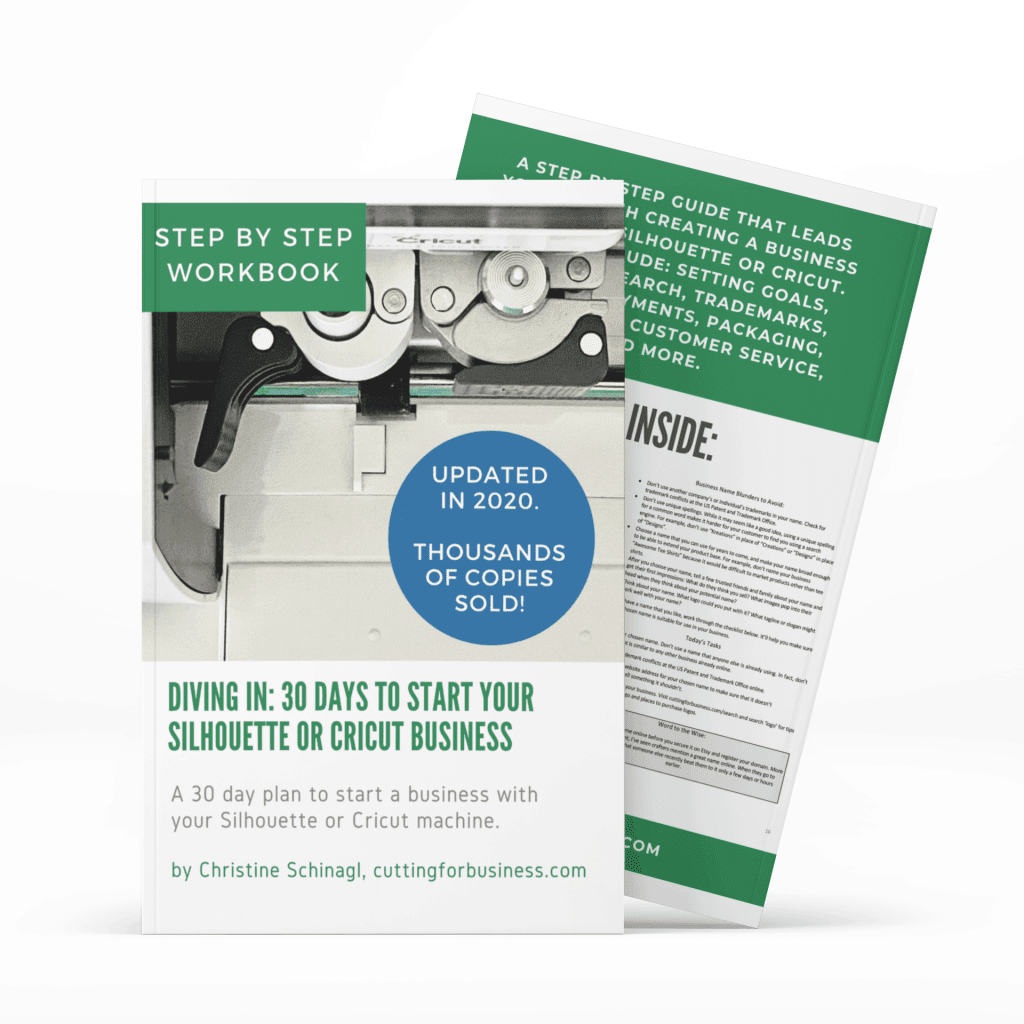
    Looking to start a business with your Silhouette or Cricut machine? Not sure where to start? Nervous about doing it ‘wrong’ or missing some important steps? Never run an online business? No problem! I’m here to help.

    In this 65 page ebook, Diving In: 30 Days to Start Your Silhouette or Cricut Business, I cover everything from setting goals to learning about licenses and choosing a business name to getting started on Etsy. Each day is broken into easy to understand text and daily tasks. After completing each task, you’ll move to the next. By the end of 30 days, your new business will be up and running.

    Buy A Copy

    Click here to buy Diving In: 30 Days to Start Your Silhouette or Cricut Business – Email Download and Print at Home

    What Readers are Saying

    I’ve sold thousands of copies of Diving In: 30 Days to Start Your Silhouette or Cricut Business. Rather than me tell you how great it is, here are actual comments from readers:

    • “Great tips! Will likely buy the next book!” -Tona
    • “I absolutely love this book!! It is exactly what i was looking for! If you want a step by step detailed guide of exact steps to take your crafting straight to a real business in 30 days this book is for you!! I love that it is broken down into daily actionable steps with detailed instructions, advice, and in workbook format so that you can keep track of all of your important information. Christine is absolutely amazing! She is really informative and insightful and shares her opinion and gives her advice from first hand experience!! This has truly saved my life!! Thanks Christine!” -Carlie
    • “Just what I needed. Provides info that I would not of thought of.” -Terri
    • “I don’t know where Christine has been since I started crafting and thinking about starting a home business. I’m glad I found her!” -Sara

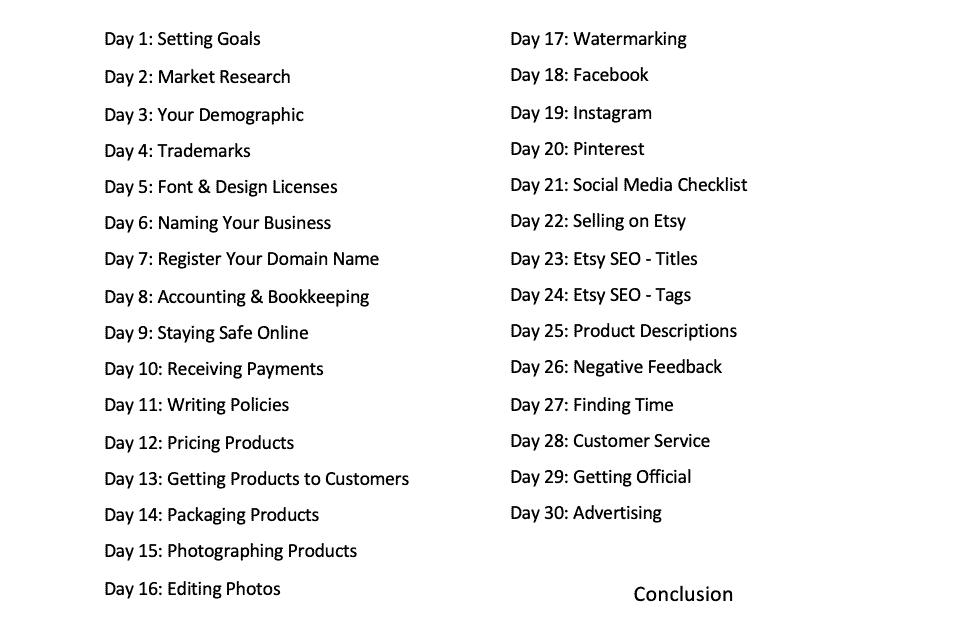
    Table of Contents

    Diving In: 30 Days to Start a Business with Your Silhouette or Cricut Table of Contents - cuttingforbusiness.com.

    Good to Know

    • Diving In: 30 Days to Start Your Silhouette or Cricut Business does not offer any product tutorials. You will need to know how to make the products you want to sell.
    • This workbook should not be read cover-to-cover. Instead, each day (1-30) is designed to be completed on separate days. Many days have tasks to complete before moving on to the next day.
    • It is best if you print out your ebook so that you can write in the workbook.
    • Diving In: 30 Days to Start Your Silhouette or Cricut Business is meant for the beginning seller or the crafter who wants to start selling their Silhouette or Cricut made products. If you are already selling online, Diving Deeper: 30 Days to Grow Your Silhouette or Cricut Business is available.
    • If you need help or have questions, I’m just a click away and my contact information is listed in the workbook.

    Buy Your Copy

    Click here to buy Diving In: 30 Days to Start Your Silhouette or Cricut Business – Email Download and Print at Home

    Diving In: 30 Days to Start Your Silhouette or Cricut Business - Portrait - Cameo - Curio - Mint - Explore - Air - Joy - by cuttingforbusiness.com
    Diving In: 30 Days to Start Your Silhouette or Cricut Business - Portrait - Cameo - Curio - Mint - Explore - Air - Joy - by cuttingforbusiness.com
  • 4 Steps to Start a Craft Business Without Debt

    Want to start a craft business but short on cash? While you may have heard the saying, “You’ve got to spend money to make money.” You certainly do not have to go into debt to start a craft business.

    Ideally, you’ll have some money set aside for your new business, but if you don’t (or if you don’t have enough) skip putting your purchases on a credit card and follow these steps instead.

    Today, let’s look at 4 steps to start a craft business without debt.

    How to Start a Craft Business without Debt - cuttingforbusiness.com.

    4 Steps to Start a Craft Business Without Debt

    1. Identify one craft product you want to sell and buy the supplies for just that product. Be selective and focus on a product that you are comfortable making, and one that you know you can sell for a profit. Then, buy the supplies to make just that product. Before you go out shopping, raid your craft stash at home. You may already have the supplies you need.
    2. Make and list your product. To save money on listing fees, consider selling locally or through social media.
    3. Immediately reinvest your profits in supplies to make more of the same product. After your product sells, Put aside all profits from your sales and reinvest those profits in supplies to make more products. Put your new products online for sale.
    4. Repeat, repeat, repeat. Repeat steps 2 and 3 and continue to repeat, repeat, repeat! You’ll be able to slowly watch your inventory and profits grow.

    An Example of How to Start Your Craft Business Without Debt

    Let’s look at this in action, with a simplified example.

    1. I’ve identified that I enjoy making t-shirts with heat transfer vinyl. I run through the numbers:
      • One t-shirt costs $6.
      • The roll of vinyl costs $10, but will make 10 shirts. So, the vinyl cost for one t-shirt costs $1.
      • This means the cost for each t-shirt is $7.
      • I already make t-shirts for my family and have a heat press and additional supplies needed.
    2. I list my t-shirt for $24 on a local buy/sell group. The buyer picks up the t-shirt from my house, so no shipping costs are incurred.
    3. My profit from this shirt is $17. This means that I am able to buy two more t-shirts, with $3 left over.
    4. I make two additional shirts and sell them in the same local buy/sell group. My profit this time is $34.
    5. I’m able to reinvest that $37 ($34 in profit + $3 left over from the first sale) for another 6 shirts. Once I sell those 6 shirts, I’ve got an additional $144 in profit. I can then reinvest my $144 in supplies and continue this process. In time, I’ll have enough money to eventually expand my product line and even buy in bulk to lower my costs.

    This method will work for most craft products. You just want to be armed with patience, as it may take longer to see results over putting everything on a credit card and paying interest.

    Coincidentally, I started my business without any debt and have slowly watched it grow and grow. Soon enough, you’ll be able to look back – debt free – and be amazed at how far you have come.

    Before you go, I’ll leave you with one of my favorite quotes:

    “It does not matter how slowly you go as long as you do not stop.”

    Confucius